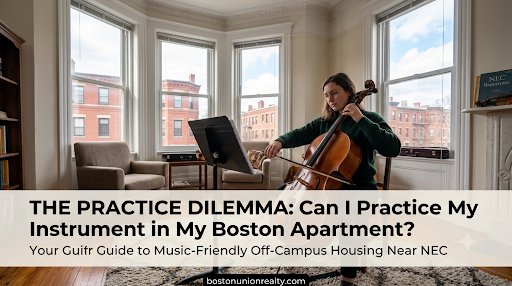
If you are a student at the New England Conservatory (NEC) preparing to move off-campus for your junior or senior year, you are likely facing a unique anxiety that normal college students don’t have to deal with.While other students are worried about finding room for a bigger TV or a second couch, you are looking at floor plans wondering: “Where am I going to put my cello?” and “Are my neighbors going to call the cops if I practice my scales at 2:00 PM?”
In a city as tightly packed as Boston, the “Practice Dilemma” is a very real challenge. Most standard Boston leases contain strict “right to quiet enjoyment” clauses, and navigating how to keep up with your conservatory workload without getting evicted requires some strategy.
Let’s look at the legal realities, building dynamics, and layout options for practicing an instrument in a Boston apartment.
Understanding Boston’s Official Noise Ordinances
Before looking at property listings, you need to understand the local law. The City of Boston has explicit rules enforced by the Air Pollution Control Commission and local law enforcement regarding excessive noise.
Here is how the Boston Municipal Code defines unreasonable noise:
- Daytime Hours (7:00 AM to 11:00 PM): Noise cannot exceed 70 decibels (dBA) when measured from the property line or an adjacent dwelling unit.
- Nighttime Quiet Hours (11:00 PM to 7:00 AM): Noise cannot exceed 50 decibels (dBA).
The Reality Check for Musicians
To put that into perspective, a normal conversation sits around 60 decibels. An opera singer, a violin, a trumpet, or a grand piano can easily blare anywhere from 80 to 110+ decibels.
Technically speaking, practicing a loud acoustic instrument can push you over the city’s legal daytime limit if your walls are paper-thin. This is why choosing the right type of building is far more important than just choosing a good location.
The Building Battle: Historic Brownstones vs. Modern Luxury
When browsing apartments near the New England Conservatory, you will generally choose between two distinct types of Boston architecture. Surprisingly, the older option is often better for musicians.
Historic Brick Brownstones (Symphony Road, St. Botolph Street)
Many upperclassmen and grad students flock to the classic brownstones scattered along Symphony Road, Gainsborough Street, and Clearway Street.
- The Pro: These historic turn-of-the-century buildings were built with thick plaster walls, heavy timber, and solid brick firewalls separating the units. Plaster is inherently much better at dampening sound than modern materials, making these buildings a classic haven for acoustic players.
- The Con: Sound can still travel through old floorboards or shared heating vents, so high-quality area rugs are a must.
Modern Luxury Buildings (Fenway / Huntington Ave)
- The Pro: They offer great amenities like central AC, elevators, and occasionally, dedicated community rooms or thick double-pane exterior windows that keep street noise out.
- The Con: Interior walls in newer constructions are frequently made of standard drywall and metal studs. Drywall acts like an acoustic drum head, meaning your neighbor down the hall might hear your woodwind practice crystal-clear.
3 Pro-Tips to Avoid Landlord & Neighbor Disputes
You don’t need to confine yourself exclusively to campus practice rooms to survive. You just need to be a strategic tenant.
1. Be Upfront Before You Sign the Lease
Do not try to hide the fact that you are a music student. When you work with an agency like Boston Union Realty, tell your agent immediately what instrument you play. We work directly with local landlords in the Symphony and Fenway areas who have rented to NEC and Berklee students for decades. They expect instrument practice and are completely fine with it, provided you follow general courtesy.
2. Establish a “Neighbor Agreement” on Day One
The moment you move in, introduce yourself to your immediate neighbors (especially those directly above, below, and beside your unit).
“Hi, I’m a performance major at NEC. I need to practice about two hours a day. Are there specific hours where you work from home or have a child sleeping so I can avoid those times?”
Giving your neighbors your phone number and creating a predictable practice window (e.g., 2:00 PM to 4:00 PM) reduces friction by 90%. If they know it will stop at a certain time, they are far less likely to file a formal complaint.
3. Invest in Temporary Soundproofing
You don’t own the apartment, so you can’t rip open the walls, but basic acoustic fixes work wonders:
- Put thick rugs down if you have hardwood floors to protect the neighbor below you.
- Keep your practice space away from shared living room walls.
- Use heavy acoustic dampening curtains over your windows and doors to absorb sound reflections.
- If you play brass or strings, look into heavy-duty practice mutes (like electronic silent mutes) for late-night or early-morning rehearsal needs.
Ready to Find a Practice-Friendly Boston Apartment?
Navigating off-campus housing as a conservatory student doesn’t have to be overwhelming. The secret is finding an apartment with the right layout, solid construction, and a landlord who welcomes the arts.We specialize in matching music students with premier brownstones and apartments just blocks away from Jordan Hall and the Student Life and Performance Center (SLPC).
Explore Active New England Conservatory Student Apartments Now!